


Many elements of a final divorce judgment cannot be changed when a divorce (called a dissolution of marriage in Florida) finalizes. However, certain elements, like alimony amounts, child support conditions, and more may be modified under certain circumstances. Below, we’ll break down eight potential situations that could lead to a court amending a divorce judgment.
Loss of Income/Employment
A divorce judgment may be modified to reflect different amounts for either alimony or child support (or both) if one party of a divorce unexpectedly and uncontrollably suffers a loss of income or employment. Note that most income reduction amendments require the reduction to be substantial for the court to approve the amendment. This is usually 15% or more.
For example, imagine that the primary breadwinner of a former couple loses their job. They may petition the court for an alimony adjustment if they can no longer make regular alimony payments.
However, a court will usually only decrease alimony if the paying party shows that their loss of income was involuntary and permanent. Voluntarily quitting one’s job is not usually grounds for a decrease in alimony. By the same token, a sudden and unexpected increase in expenses – such as healthcare bills – may lead to a change in alimony or child support payments for the paying party.
But once more, the requesting party must prove to the court that the increase in expenses was involuntary. The expense increase must also be unlikely to change in the near future. Income reductions may impact child support and timesharing arrangements. If an individual loses the ability to provide financially for their children, the other parent may request a divorce modification that removes childcare privileges, either temporarily or permanently.
Increase in Income
One party’s sudden increase in income may lead to modifications of a divorce judgment. For instance, an individual receiving alimony proves that the person paying alimony received a promotion at work. Then they may request an increase in alimony payments.
Income increases may also affect child support arrangements. Imagine that one party in a divorce settlement is not allowed childcare privileges due to a lack of income. If they later prove that they receive a steady income of a certain amount, they may convince the court to adjust childcare privileges to reflect this new responsibility.
An income increase may even extend to alimony adjustments. If one party receives alimony immediately after divorce but then receives a promotion at work and begins earning substantially more income, the paying party may request a reduction or elimination of alimony.
As with income reduction amendments, income increase amendments must be provable to the court through documentation, testimony, and other forms of evidence.
Proven Mistreatment of Child(ren)
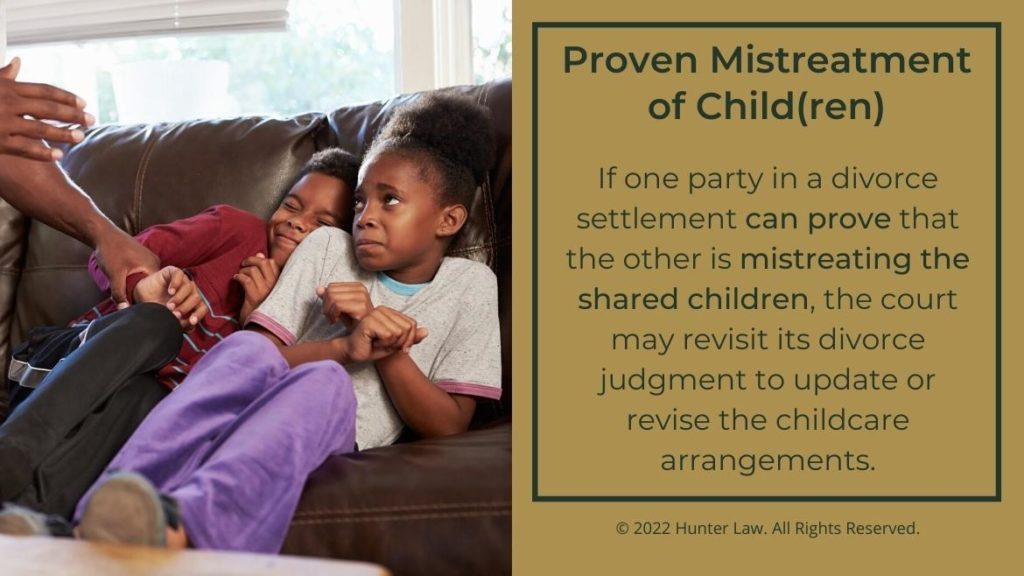
Florida courts take child support and child mistreatment very seriously. If one party in a divorce settlement can prove that the other is mistreating the shared children, the court may revisit its divorce judgment to update or revise the childcare arrangements.
However, the bar for such an amendment is very high. One parent simply disagreeing with the parenting practices of the other is not normally grounds for amending childcare arrangements in a divorce.
Relocation of One or Both Parties
If one party in a divorce relocates far from the other, one or both parties in the divorce could request multiple amendments to the judgment, including:
- Childcare and child support arrangements
- Alimony changes
For example, imagine a former couple that shares custody of their child. One parent moves far away and is unable to spend as much time with the child as before. The couple could then renegotiate childcare scheduling and time requirements with the court.
Relocating With Your Child After Divorce in FL
One Party Does Not Meet the Current Terms of the Decree
A divorce judgment typically outlines specific requirements or terms that both parties must adhere to. If one party doesn’t meet the current terms of the decree, it could lead to harsh penalties and revisions to the divorce judgment.
For instance, a divorce judgment may require the former or current breadwinner to provide a certain amount of child support to the other parent. If the breadwinner parent does not pay child support, the divorce judgment could be amended to remove childcare and visitation rights from that parent entirely.
Incarceration
Incarceration is a serious matter that may affect divorce judgments or terms severely. Incarceration could cause:
- A party to be unable to pay for alimony or child support
- A party to be unable to visit their child or assist with childcare
If either of these applies to a divorce judgment, that judgment may be amended to reflect the incarcerated state or one or both parties.
Remarriage of One or Both Parties
Florida state law maintains many of its divorce provisions under the assumption that both parties remain unmarried. If one or both parties become married to another partner, certain amendments may be necessary.
The most common of these is an adjustment to alimony amounts. For example, imagine that one party receives alimony from their former partner. Later, that party gets married to another employed individual. In this instance, the paying party may request an amendment to the divorce judgment. The court would be likely to grant an alimony reduction or elimination to reflect the new monetary support status of the first party.
Marriage may also affect child visitation or timesharing arrangements, child support amounts, and even primary visitation rights.
Contact Tampa Family Law Attorneys Today
Ultimately, every divorce case presents unique situations. That’s why it’s important to contact knowledgeable family law attorneys in Tampa if you’re concerned about your divorce judgment or wish to request a modification from the court.
With our expertise and support, we can help you get the best verdict possible for your divorce case, or work to improve your chances of getting the divorce amendment you need. We can also provide you with advice if you wish to seek a specific amendment to your divorce judgment.
Contact us today to learn more and schedule a complimentary consultation.