


Divorce is a complex and stressful process for everyone involved, especially if you have kids. Understanding child custody in a divorce is crucial so you know what to expect and how to be the best parent possible for your children. Contact knowledgeable Tampa family law lawyers today or read on for more information about child custody laws in Florida.
Divorced Parental Rights in Florida
During a divorce, Florida child custody laws recognize that children benefit from contact with both parents, not just one or the other. Unlike in some other states, most Florida divorce cases end with both parents having some “timesharing” (visitation) rights.
Florida law does not give either parent an advantage or preference. In Florida, the expectation is that parents have “shared” parental responsibilities and “shared” parental time-sharing with their children. How parental responsibility and parental timesharing are shared comes down to what is in the best interests of the children.
When ruling on a Florida child custody case, a judge will determine timesharing and parental responsibility rights for each parent.
Parenting Time or “Timesharing”
Parenting time, or “timesharing,” refers to the amount of time each parent spends with the child. Most Florida judges will draw up a timesharing child custody schedule. This establishes visitation and custody schedules for both parents in the case.
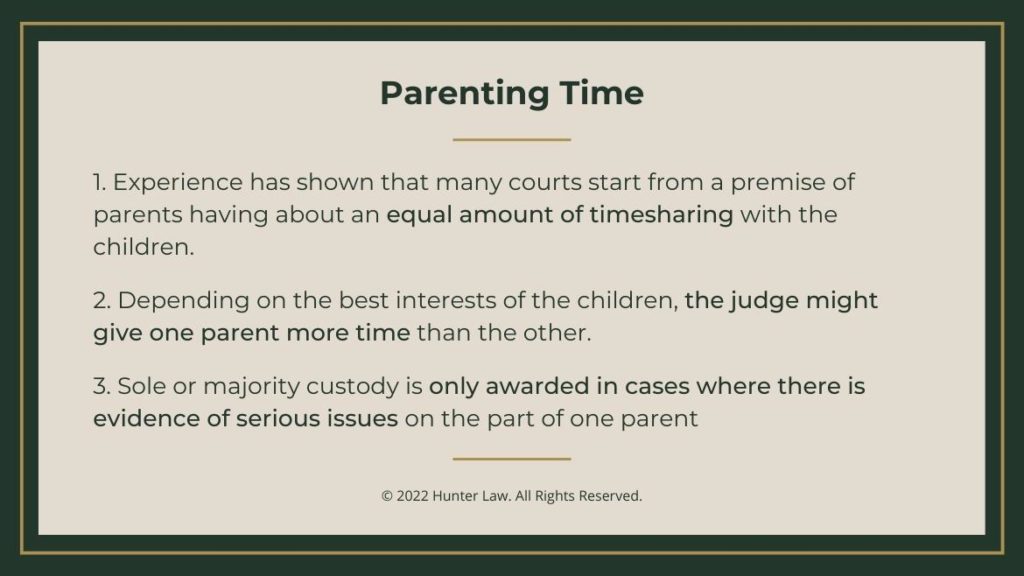
Although not specifically required by Florida law, experience has shown that many courts start from a premise of parents having about an equal amount of timesharing with their children. This is sometimes referred to as “joint custody,” although that is not the Florida legal terminology. However, depending on the best interests of the children, the judge might give one parent more time than the other. Such parents may be informally referred to as the majority timesharing parent. In extreme cases, it may even be “sole timesharing” for one parent, as the other parent may only be allowed to see the child under supervised conditions, or not at all.
Sole or majority custody is only awarded in cases where there is evidence of serious issues on the part of one parent, such as child abuse, domestic violence, or criminal activity related to the person’s ability to safely parent the child.
Read more in our blog: Facts About Domestic Violence and Psychological Abuse
Parental Rights and Responsibilities
Parental rights and responsibilities include each parent’s ability to make important decisions on behalf of the child, such as medical, educational, and religious decisions.
Judges may give one parent “sole decision-making authority” for a child if they determine that joint decision-making is not in the child’s best interests. For instance, if both parents can’t agree on where their child should attend school, the judge may give one parent the authority to decide where the child should attend school, to prevent the child from changing schools frequently.
Regardless of how parental timesharing and parental rights and responsibilities are awarded/assigned, certain federal laws call for one parent to be designated the “primary” or “custodial” parent for the child in question. The second parent is designated the “secondary” or “noncustodial” parent but this designation does not have any impact on their parental timesharing or parental rights and responsibilities.
How Is Child Custody in Florida Decided for Children of Divorced Couples?
Judges determine child custody rights, including parental timesharing and parental rights and responsibilities, by considering a wide range of factors to determine the best interests of the children. In Florida, as in other states, the child’s best interests are considered rather than the feelings or opinions of both parents.
A divorce court judge may consider each parent’s past actions and whether the parents have demonstrated the ability and/or desire to meet the child’s developmental needs and be involved in the child’s life. More specifically, they may look at factors like:
- The physical and mental health of each parent
- The moral fitness of each parent. Moral fitness typically refers to any behaviors that may affect the moral and ethical development of the child, such as substance abuse, verbal abuse, illegal behavior, or casual intimate relationships with many partners
- The willingness of each parent to foster a relationship between themselves and the child
- The ability of each parent to provide the child in question with a consistent routine
- Whether there is evidence of mistreatment or domestic violence
- Whether each parent can provide a safe and stable environment for the child
Furthermore, judges consider geographic issues surrounding the parenting plan. For example, if both parents live far apart, timesharing may require that the child live at one house on the weekends and another during the week to attend school.
Read more in our blog: Fathers’ Parental (Custody) Rights: How to Prepare & Negotiate in Tampa, Florida
Child Custody in Florida Requires Communication and Willingness to Cooperate
One of the most important factors when determining child custody in Florida is whether one or both parents show communication and a willingness to cooperate. During a Florida divorce, parents are expected to at least try to protect their child from the stress of the matter.
If either parent is caught trying to sway their child against the other parent, they could face penalties in the eyes of the divorce court. Judges also consider how each parent can communicate with the other, as this is an important part of carrying out the court-ordered parenting plan.
If one parent is better at communicating than the other, they may expect to receive greater timesharing and child custody rights.

What Are Florida Parenting Plans?
A Florida parenting plan is a document that outlines the parental rights and responsibilities, and the parental timesharing, for each parent. Both parents must adhere to the parenting plan, whether it is one to which they agreed or one imposed by the court, or face court penalties, up to and including the loss of timesharing and a reduction in their parental rights and responsibilities.
Each Florida parenting plan includes details such as:
- The custody timesharing schedule for both parents
- The assigned responsibilities for daily parenting tasks
- The designated addresses for schools and each parent’s primary place of residence
- An outline of how the parents will communicate with each other
- A note indicating which parent is responsible for major decisions, like healthcare decisions, if not equally shared
Can You Modify Child Custody Orders in Florida?
Yes, but it must be approved by a family court judge. Either parent in a Florida divorce can submit a custody modification request. For the request to be approved, they must show that something both substantial and unanticipated has changed since the last order was entered by the court and that the proposed change is in the child’s best interests.
Read more in our blog: Key Steps for a Successful Florida Parenting Plan
For example, if one parent has evidence that the other is abusing the child at home, resulting in reductions in school grades, they can petition the court to have more or sole custody of the child. Tampa family law attorneys can help parents gather evidence like this or help navigate the complex custody modification process. Read more in our blog: Can I Use Recordings of My Spouse for Child Custody Evidence?
Contact Tampa Family Law Lawyers About Child Custody Laws in Florida
You may still have questions about Florida’s child custody laws. No matter the circumstances of your divorce case, experienced Tampa, Florida family law lawyers can help.
Hunter Law has handled cases just like yours and can help you understand child custody laws and ensure your interests are represented as well as possible. Contact us today to learn more.