
Military Divorce in Tampa, Florida, can involve both Florida divorce law and federal military rules. Florida law governs divorce and division of marital property, while federal law governs how military retired pay and certain former-spouse benefits are handled. If retirement is a major concern, understanding USFSPA, DFAS, SBP, the 10/10 rule, and the 20/20/20 rule can prevent costly misunderstandings.
Hunter Law helps servicemembers and military spouses understand how these rules may affect their divorce. Contact Hunter Law today to schedule a consultation and discuss your military divorce, retirement benefits, and former-spouse benefit concerns.
How Does Divorce Work in the Military?
Getting divorced in the military is still handled under state divorce law. In Florida, that includes rules governing the dissolution of the marriage and the division of marital assets. Military service adds federal requirements that can affect retirement pay and benefits.
Florida law generally treats retirement benefits earned during the marriage as marital assets subject to equitable distribution. That can include the marital portion of military retirement. It does not mean a former spouse automatically receives half of the service member’s entire pension. Hunter Law’s guide to how Florida courts divide property in a divorce explains the process in more detail.

How Does USFSPA Affect Military Retirement in a Florida Divorce?
The Uniformed Services Former Spouses’ Protection Act (USFSPA) allows state courts to treat qualifying military retired pay as property in a divorce. It also provides a way to enforce certain retirement awards through direct payments when federal requirements are satisfied.
USFSPA does not automatically give a military spouse a part of the retirement. A court must award the former spouse a share. DFAS also calculates percentage awards using “disposable retired pay,” a federal term that can differ from gross retired pay.
For more information about related military divorce laws, see Hunter Law’s military divorce practice area.
What Is the 10/10 Rule in a Military Divorce?
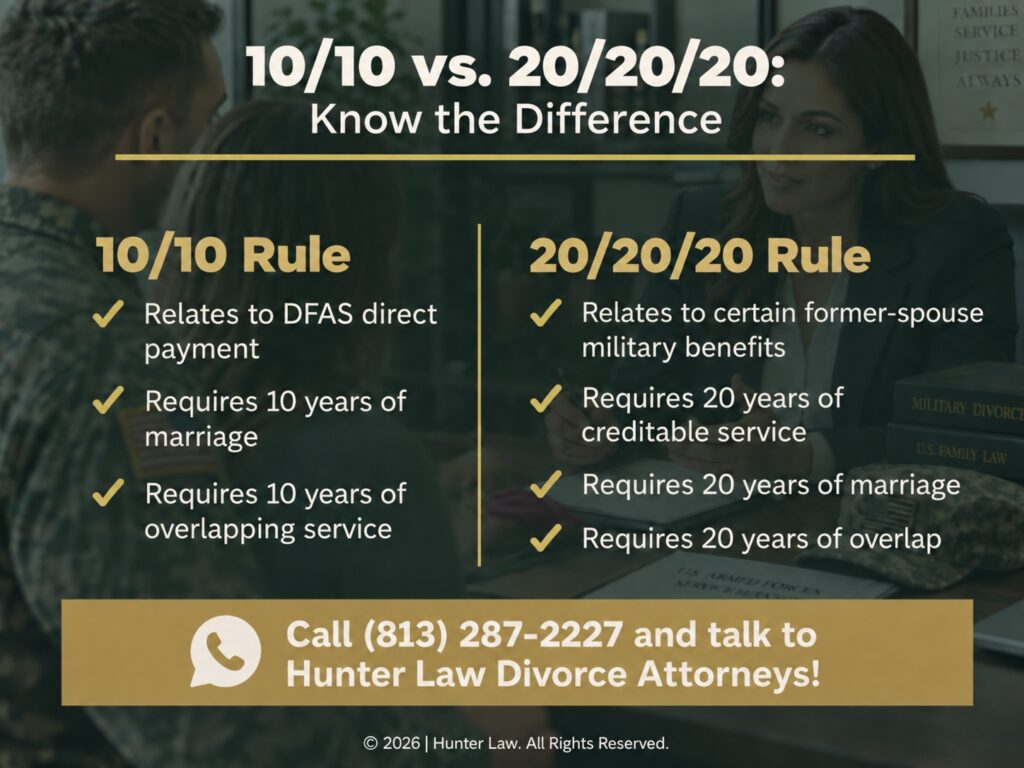
The 10/10 rule military divorce requirement is commonly misunderstood. For direct payment of retired pay as property through DFAS, the marriage must have lasted at least 10 years, with at least 10 years overlapping creditable military service.
The key distinction is simple: the 10/10 rule affects how a qualifying retirement award can be paid. It does not determine whether military retirement can be divided.
What If the Marriage Lasted Less Than 10 Years?
A marriage that does not meet the 10/10 requirement can still involve division of the marital portion of military retirement. A military spouse’s divorce after 10 years may qualify for DFAS direct payment when the required service overlap is also met. If the overlap is not met, then the servicemember must pay the former spouse their share of the retirement directly. This often leads to issues related to taxation, as military retirement pay is taxable as income to the recipients.
What Does DFAS Do After a Military Divorce?
The Defense Finance and Accounting Service (DFAS) administers qualifying direct payments. It does not decide how much retirement a former spouse should receive.
A former spouse seeking direct payments under USFSPA generally submits DD Form 2293 and a certified copy of the relevant court order. Other documentation may be required depending on the case. The wording of the retirement award matters because the order must meet DFAS requirements before direct payments can be processed.
Hunter Law also discusses retirement and other military-specific concerns in its guide to military divorce rights and options.
How Does SBP Protect a Former Military Spouse?
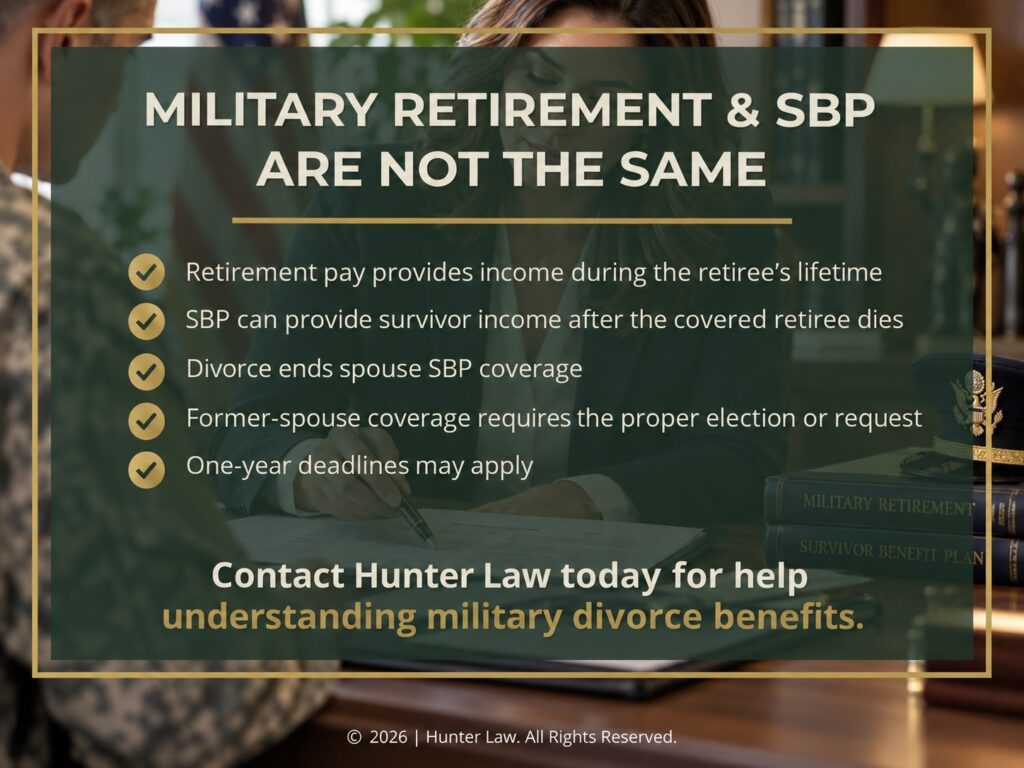
The Survivor Benefit Plan (SBP) addresses a separate issue: survivor income after a covered military retiree dies. Receiving part of retired pay while the retiree is alive does not automatically create former-spouse SBP coverage.
DFAS explains that spouse SBP coverage ends upon divorce. Former-spouse coverage requires the proper election or, when applicable, a timely deemed-election request. One-year deadlines can apply, so SBP should be addressed while divorce terms are being finalized rather than treated as an afterthought.
What Is the 20/20/20 Military Divorce Rule?
The 20/20/20 military divorce rule concerns certain former-spouse military benefits, not the amount of retirement a former spouse receives. To qualify for TRICARE coverage, one generally requires at least 20 years of creditable service, 20 years of marriage, and 20 years of overlap between the marriage and service.
The difference is worth remembering: 10/10 can affect DFAS direct payment of a retirement award; 20/20/20 can affect certain former-spouse benefits such as TRICARE.
Get Help With a Military Divorce in Tampa, Florida
The Military retirement division can become complicated when Florida equitable distribution rules intersect with USFSPA, DFAS, and SBP requirements. Hunter Law works with service members and military spouses in Tampa, Florida, facing these issues. Learn more about the firm’s family law services or contact Hunter Law to discuss how military retirement and former-spouse benefits may affect your divorce.